
Founders often play an important role in shaping a charity or non-profit organization. They may have developed the original vision, recruited the first board members, established relationships with donors, and spent years building trust within the community. Over time, however, an organization that depends too heavily on one person can face serious challenges when that person decides to retire, reduce their involvement, or leave unexpectedly.
Founder-led organizations often reach a point where informal practices that worked well in the early years no longer provide enough structure. Important relationships, passwords, banking authority, contracts, and organizational knowledge may all be concentrated with the founder. Nonprofit succession planning in BC helps address these issues before a leadership change becomes urgent.
A successful charity founder transition is not about replacing everything the founder built. It is about preserving that work while ensuring the organization can continue to serve its charitable purposes well into the future.
Recognizing the Risks of Founder Dependency
Founder involvement can be an enormous strength, but problems arise when too much authority or information rests with one individual. The founder may be the primary contact for donors, hold signing authority over bank accounts, manage government filings, maintain passwords, supervise staff, and sustain relationships with key partners.
If that individual suddenly becomes unavailable, the organization may struggle to perform basic tasks. Board members might discover they cannot access financial accounts, retrieve important records, renew contracts, or communicate with key donors. What appeared to be an efficient arrangement can quickly become a serious operational problem.
Legal Counsel in Strategic Planning concerns can surface as well. A society is a separate legal organization and should be governed according to its constitution, bylaws, applicable legislation, and the decisions of its board and members. Even where a founder remains highly influential, the board continues to carry its own responsibilities. Directors should understand their duties and feel comfortable exercising appropriate oversight.
A nonprofit leadership transition can expose weaknesses that have developed gradually. Board meetings may have become informal because the founder handles most decisions. Policies may not have been updated for years, or the bylaws may no longer reflect how the organization operates. Succession planning provides an opportunity to identify these issues while there is still time to address them thoughtfully.
Preparing the Board and Organization for Transition
Good succession planning should begin well before a departure date is announced. One of the first priorities is ensuring that the board understands how the organization operates and where important information is located.
Signing authority should be reviewed carefully. Banking, contracts, government accounts, insurance policies, payroll systems, domain names, websites, social media accounts, and cloud storage should not depend entirely on one person’s access. Organizations should maintain secure records showing who has authority and how access can be transferred when leadership changes.
The board should also review its governing documents. Bylaws may contain provisions dealing with directors, officers, elections, vacancies, meetings, and decision-making authority. If these documents no longer reflect the organization’s needs, amendments may be appropriate as part of society continuity planning in BC.
Employment and contractor arrangements may require attention as well. A founder may serve simultaneously as a director, employee, executive director, or contractor if certain conditions are met. Those roles should be clearly distinguished. When a founder steps away from one position but remains involved in another, everyone should understand where their authority begins and ends.
Relationships are another important part of any transition. Donors, community partners, employees, and volunteers may have dealt primarily with the founder for many years. Introducing other leaders before the transition helps move those relationships from the individual to the organization itself.
The founder can play a valuable role in this process by documenting institutional knowledge and helping new leaders understand the history behind important decisions. A thoughtful handover can preserve accumulated experience without preventing the next generation of leadership from developing its own approach.
Building an Organization That Can Continue Without Its Founder
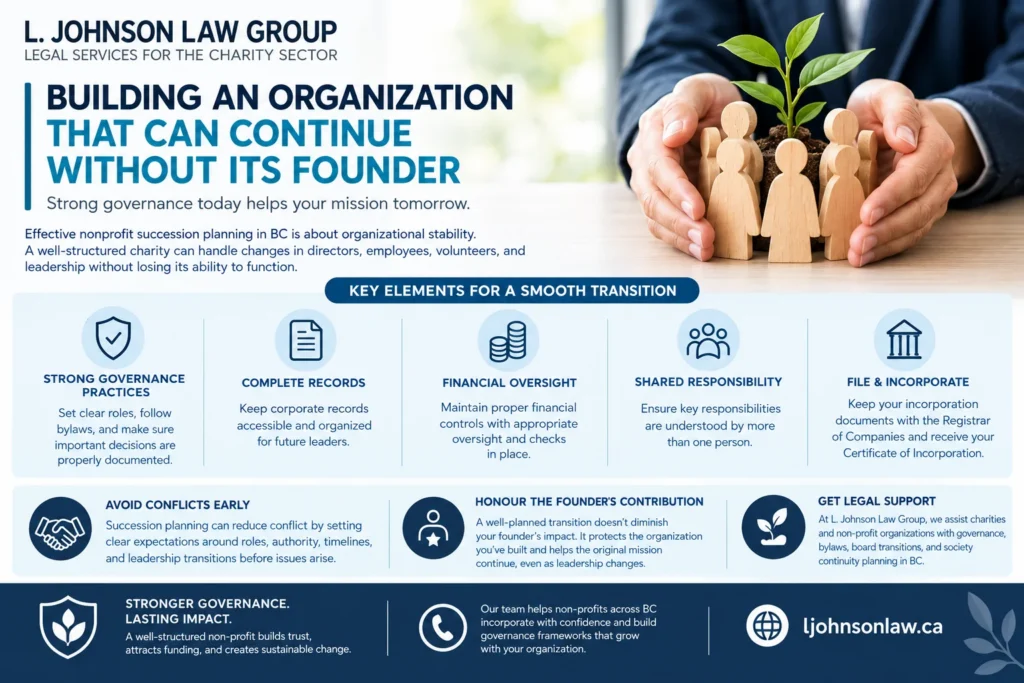
Effective nonprofit succession planning in BC is ultimately about organizational stability. A strong charity should be able to experience changes in directors, employees, volunteers, and senior leadership without losing its ability to function.
This means establishing clear governance practices rather than relying on individual habits. Important decisions should be properly documented. Corporate records should be complete and accessible. Financial controls should involve appropriate oversight, and key responsibilities should be understood by more than one person.
Succession planning can also help reduce conflict. Founder transitions sometimes become difficult when expectations have never been clearly discussed. A founder may expect to remain closely involved while a new executive director or board believes a clean transition is necessary. Discussing roles, authority, timelines, and expectations in advance can prevent misunderstandings from becoming larger disputes.
The process does not need to diminish the founder’s contribution. In many cases, a well-planned transition is one of the most meaningful steps a founder can take to protect the organization they worked so hard to establish. Strong governance allows the original mission to continue even as the people responsible for carrying it forward change.
At L. Johnson Law Group, we assist charities and non-profit organizations with governance, bylaws, board transitions, and society continuity planning in BC. If your organization is preparing for a charity founder transition or considering how to strengthen its succession plan before leadership changes occur, we are here to help you put a practical legal framework in place for the years ahead.
Planning a leadership transition for your organization? Contact L. Johnson Law Group to discuss a succession plan that fits your charity.
Frequently Asked Questions
1. When should a non-profit begin succession planning?
Ideally, succession planning should begin before a departure is anticipated. Having procedures in place for both planned and unexpected leadership changes gives the board time to transfer knowledge, authority, and important relationships properly.
2. What happens if a charity founder suddenly leaves?
The impact depends on how responsibilities have been structured. If the founder controls important accounts, records, or relationships, the organization may experience significant disruption. A continuity plan helps ensure other authorized people are able to keep operations moving.
3. Should a founder remain on the board after stepping down?
There is no single answer that suits every organization. Remaining on the board may provide useful continuity in some situations, while a cleaner separation may work better in others. The organization’s bylaws, governance needs, and the roles of incoming leaders should all be considered.
4. Should signing authority be changed during a leadership transition?
Yes. Signing authorities and account access should be reviewed whenever key personnel change. This can include bank accounts, contracts, government accounts, technology platforms, and other systems used to conduct the organization’s affairs.
5. Do bylaws need to be updated when a founder leaves?
Not necessarily, but a founder transition is a good opportunity to review them. If the bylaws no longer reflect how directors, officers, members, or leadership positions operate in practice, amendments may help strengthen governance for the future.
6. How can a charity make a leadership transition easier?
Planning early is one of the most effective approaches. Clear documentation, shared access to important information, strong board involvement, well-defined roles, and careful communication with staff, donors, and partners can all contribute to a smoother nonprofit leadership transition.